10 Headline Angles That Never Fail: The Science of Hook Writing
Great headlines aren't born from sudden inspiration; they are constructed using proven psychological frameworks. Explore 10 angles top publishers use to demand attention across social and search.
The 80/20 Truth of Digital Copywriting
David Ogilvy famously noted that on average, five times as many people read the headline as read the body copy. In today's hyper-saturated digital landscape, that ratio is closer to 8 out of 10. Whether you are publishing an SEO article, launching a newsletter, or posting on LinkedIn, your headline is the single gatekeeper of your reach.
If your hook fails, your entire investment in research, writing, and design becomes invisible. The world's best copywriters do not wait for inspiration; they construct headlines using proven psychological formulas.
The 10 Proven Headline Frameworks
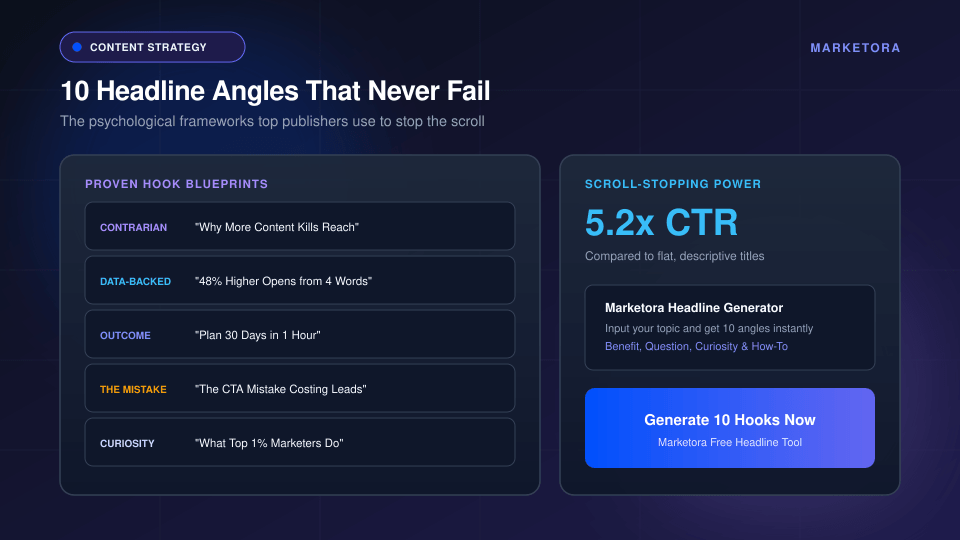
Here are 10 headline blueprints that consistently generate 3x to 5x higher click-through rates across channels:
1. The Contrarian Stance
Formula: Why Conventional Strategy Leads to Stagnant Pipeline.
Example: 'Why Publishing Daily Content is Destroying Your Organic Reach'
Psychology: Challenges accepted wisdom, prompting readers to verify if their current strategy contains a critical blind spot.
2. The Data-Backed Proof Hook
Formula: Quantified Benchmark Metric combined with Actionable Insight.
Example: 'Case Study: How 4 Words in the Subject Line Lifted Opens by 48%'
Psychology: Signals objective, research-backed reality rather than subjective opinion.
3. The Direct Outcome Promise
Formula: How to Achieve Your Primary Goal Without Common Friction Points.
Example: 'How to Plan a 30-Day Campaign Without Hiring a Marketing Agency'
Psychology: Promises a valuable outcome while immediately neutralizing the reader's primary hesitation.
4. The Costly Mistake to Avoid
Formula: The Single Most Critical Mistake Leaking Your Conversion Rate.
Example: 'The Number One CTA Mistake Leaking 40% of Your Landing Page Conversions'
Psychology: Triggers loss aversion, which behavioral psychologists prove is twice as motivating as gain seeking.
5. The Numbered Playbook
Formula: Actionable Numbered Frameworks to Achieve Measurable Results.
Example: '7 Non-Negotiable Sections of a High-Ranked SEO Brief'
Psychology: Provides quantifiable structure and promises an easy-to-digest reading experience.
6. The Curiosity Gap Hook
Formula: What Top-Performing Leaders Do Differently in Daily Execution.
Example: 'What High-Growth Solo Founders Do Differently on Social'
Psychology: Teases exclusive insider methodology that the reader feels compelled to uncover.
7. The Step-by-Step How-To
Formula: How Lean Teams Can Execute High-Impact Campaigns in Minutes.
Example: 'How Small Teams Can Build High-Converting Content Briefs in 10 Minutes'
Psychology: Direct, actionable instruction tailored specifically to the reader's identity.
8. The Urgent Warning
Formula: Is Your Core Channel Secretly Triggering Hidden Deliverability Friction?
Example: 'Is Your Email Sequence Secretly Landing in the Promotions Tab?'
Psychology: Creates an urgent need for an immediate self-audit.
9. The 'What If' Scenario
Formula: What Happens When You Replace Outdated Tactics With Frictionless Workflows.
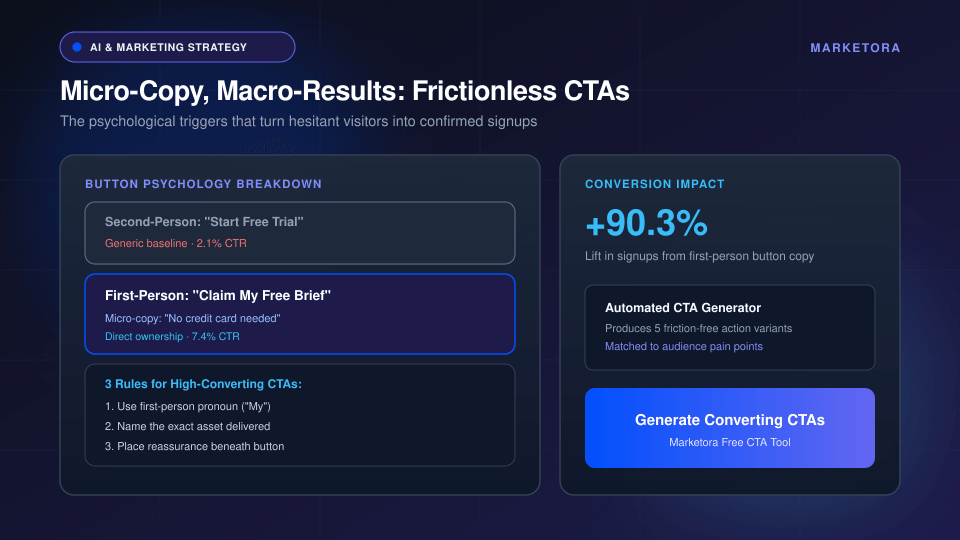
Example: 'What Happens When You Replace Generic Buttons with First-Person CTAs'
Psychology: Frames the change as an intriguing low-risk experiment.
10. The Ultimate Resource
Formula: The Definitive Playbook and Strategic Checklist for 2026.
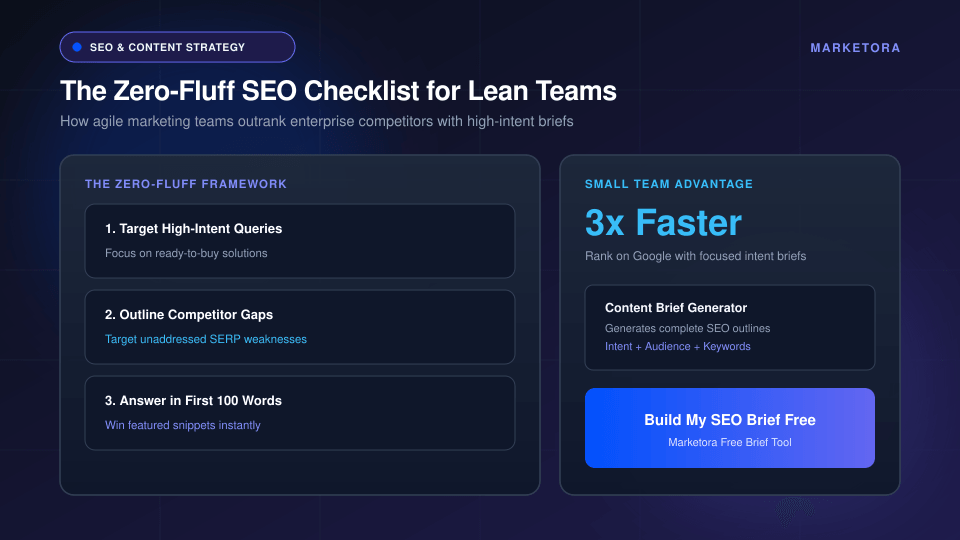
Example: 'The Zero-Fluff SEO Checklist for Lean Teams in 2026'
Psychology: Positions the article as the definitive, bookmarked guide for the topic.
Never Settle for Your First Headline Draft
Top editorial teams generate at least 10 distinct headline angles before selecting the winner for distribution. Use Marketora's Headline Generator to test and compare 10 proven angles in seconds.