The Zero-Fluff SEO Checklist: How Small Teams Outrank Big Competitors in 2026
Big brands dominate broad head terms with massive budgets. Discover how lean teams target high-intent long-tail keywords to rank faster and generate qualified pipeline with less effort.
The Head Term Trap: Why Small Teams Waste Months on Unwinnable SERPs
When lean marketing teams begin their SEO journey, they frequently fall into the 'head term trap'. They target massive keyword terms like 'email marketing software' or 'CRM platform', competing directly against venture-backed enterprise brands with domain ratings above 85 and seven-figure monthly backlink budgets.
The result is predictable: months of writing, zero organic rankings, and demoralized founders who conclude that SEO doesn't work for small companies. In 2026, agile teams win through search intent precision rather than sheer keyword volume.
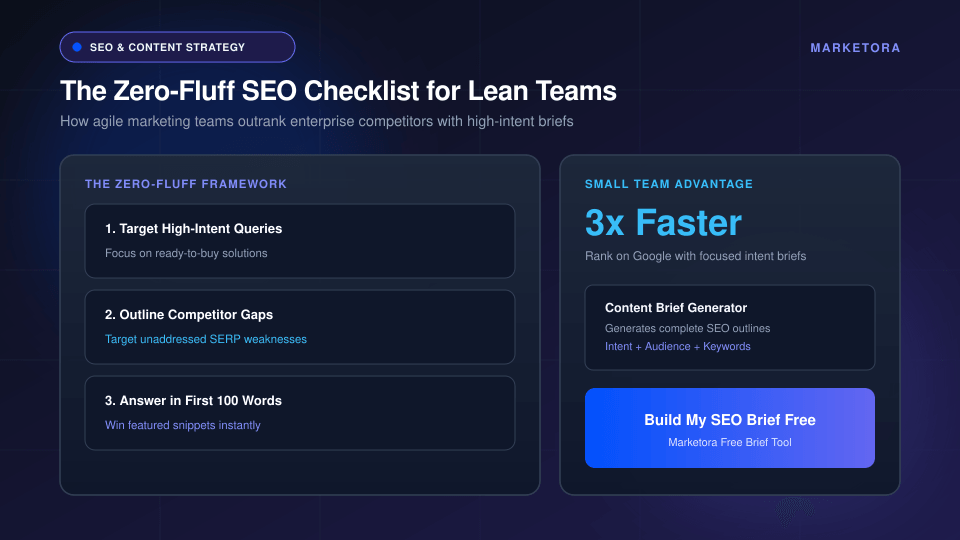
The Zero-Fluff Framework: Targeting High-Intent Long-Tail Queries
High-ranking lean teams don't write for algorithms—they answer specific, urgent commercial questions that enterprise blogs ignore as 'too low volume'. Here is the 4-step framework:
Step 1: Mapping Commercial Intent vs Informational Curiosity
A query like 'what is marketing automation' is informational, bringing college students and casual browsers. In contrast, 'marketing automation tools for solo marketers under $100' has high commercial purchase intent. 50 monthly visitors with commercial intent are worth more than 5,000 casual readers who will never buy.
Step 2: The 10-Minute Competitor Gap Analysis
Search for your target query in Google. Look at the top 3 ranking results. What did they fail to explain? Do they lack actionable examples, checklists, or pricing breakdowns? Your article's competitive moat is filling the exact information gaps that large, generic agency content glossed over.
Step 3: Structuring the Perfect Search-Ranked Outline
Never draft content directly from a blank screen. Plan your H2 and H3 headings beforehand to guarantee full coverage of supporting search queries. When your outline directly matches what search engines look for, your article ranks in days instead of months.
Answering the Primary Question in the First 100 Words
Google's Helpful Content algorithms heavily prioritize immediate value over page bloat. If a user has to scroll past three paragraphs of generic back-story just to find an answer, your bounce rate spikes. State your direct answer in the very first 100 words, then expand with deep actionable context throughout the body.
Embed an In-Article Action Tool
A top Google ranking is useless if visitors read your article and leave immediately. Embed dedicated interactive tools—such as a Content Brief Generator or Headline Tester—inside the article to convert passive search traffic into active product users.